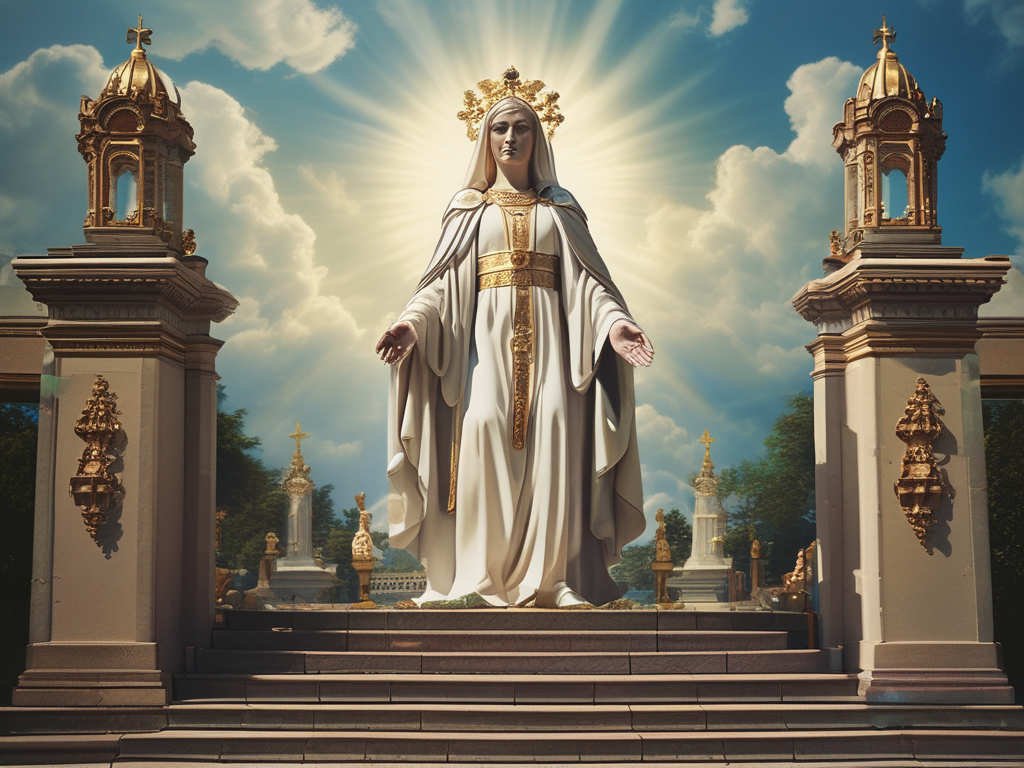
The Babylonian system, with its occult practices, continues to influence modern religion, often hidden in plain sight. One fascinating example of this is the worship of the Queen of Heaven, a practice not many know is rooted in ancient Babylonian religion.
In ancient Mesopotamia, around 2500 B.C., the Queen of Heaven was revered as Ishtar, a powerful female deity. The inhabitants of Ur of the Chaldees in Sumeria worshipped her as their mother-goddess. The Book of Jeremiah provides valuable insight, mentioning the Queen of Heaven in two passages (Jeremiah 7:18 and Jeremiah 44:17-19), both written before Jesus’ birth.
This conflict generates debate about whether the Catholic Church adopted the Babylonian Queen of Heaven worship, as there is no biblical verse that specifically describes Mary as the Queen of Heaven. This also leaves one big question: Is the Queen of Heaven in the Old Testament the same as Mary, the mother of Jesus?
The Connection between Nimrod and the Queen of Heaven
The biblical figure of Nimrod has long fascinated scholars, who continue to unravel the mysteries surrounding this powerful and legendary hunter-king. Described in Genesis, the first book of the Christian Bible, Nimrod’s story has sparked intense interest. According to Genesis 10:9, Nimrod was a formidable hunter and warrior, earning him a reputation that may be reflected in his name. As the son of Kush and a member of Ham’s family, Nimrod’s ancestry is well-documented. Interestingly, his name is believed to have Semitic origins, rooted in ancient Hebrew.
Some rabbinic scholars interpret the name Nimrod to mean “rebel” in Hebrew, a claim supported by Genesis’ portrayal of Nimrod as a man who defied God. The biblical phrase “a mighty hunter before the Lord” can also be translated as “against the face of God,” suggesting that Nimrod was a powerful hunter who opposed God. While the Bible and most historical texts refer to him as Nimrod, some believe he may have been known by other names or titles in ancient traditions. Here are some of the names associated with Nimrod:
- In the Bible, “Nimrod the Hunter” is the most common name for him.
- Ninus is a character many believe could be Nimrod, in ancient Assyrian and Greek traditions. Ninus is said to have founded Nineveh.
- In some mythologies and religious traditions, Nimrod is associated with the deity Baal, although this association is not found in the Bible.
- Nimrod has been associated with Marduk, a significant deity in Mesopotamian mythology and Babylonian traditions.
- Some scholars have drawn parallels between the characters of Nimrod and Gilgamesh in the Epic of Gilgamesh, an ancient Mesopotamian epic.
The story of Nimrod becomes even more complex and intriguing with the introduction of his mother, Semiramis, who is also believed to be his wife. According to the Greek historian Eusebius, Semiramis played both roles in Nimrod’s life. In Sumerian, she is referred to as Sammur-amat. The apocryphal book of Jasher reveals that Semiramis was the daughter of Shem, making her potentially Noah’s great-granddaughter. As a prominent figure in ancient Mesopotamia, Semiramis was a powerful queen of Assyria and Babylon, known for her military victories and architectural achievements.
The theory that Semiramis was Nimrod’s wife was further explored by Alexander Hislop in his work, The Two Babylons. According to Hislop, Nimrod’s marriage to his mother was a grave sin, which displeased God. Following Nimrod’s death, Semiramis seized control of Babylon, performing a ritual to honor her son/husband. She deceived her people by claiming that Nimrod had been resurrected as the sun god, and that he had miraculously impregnated her with a child, Tammuz.
Tammuz, believed to be the reincarnation of Nimrod, inherited his father’s hunting skills but met an untimely demise, devoured by a wild pig during a hunting expedition. Semiramis established a 40-day mourning period in commemoration of Tammuz, which involved the killing and consumption of a wild pig. Semiramis’s reign was also marked by wickedness and satanic occult worship, perpetuating the practice of incest throughout Babylon. This, in turn, contributed to the spread of false religions worldwide.
The worship of Semiramis, Nimrod, and Tammuz as sun god deities spread rapidly across cultures, from Babylon and Sumeria to Mesopotamia and Rome. Their followers, deeply entrenched in sin and occultism, even sacrificed infants in their honor, believing them to be incarnations of the sun gods.
This devotion ultimately gave rise to the doctrine of the Trinity. In this pantheon, Nimrod was revered as the sun god, Semiramis as the queen of heaven, and Tammuz as the son of god or sun god. Under Semiramis’s influence, mother/child worship statues proliferated throughout Babylon and beyond. Following the invasion of Babylon by the King of the Medes and Persians in 539 BC, her worship extended far and wide.
The priests of Semiramis fled to Alexandria and Pergamos after the invasion. Later, in 129 BC, most Semiramian priests relocated from Pergamos to Rome, establishing Rome as the new hub for Semiramis’s religion. The Romans, too, began to follow the sun god religion, which gained immense popularity in Alexandria and Rome during Christ’s time.
As the Roman Empire expanded, conquering and colonizing vast territories, they exported the Semiramis religion along with their conquests. Consequently, remnants of this ancient faith found their way into the Catholic religion, which emerged from the Roman Empire. The construction of statues honouring the Queen of Heaven became widespread, and pagan holidays like Christmas and Easter gained acceptance.
The book of Jeremiah reveals that the Almighty God was displeased with the children of Israel for participating in ceremonies honouring Semiramis, foreshadowing her significant impact on the future. This was revealed in Jeremiah 7:16-18, where the creator expressed disappointment with the Israelites’ idolatrous ways and their worship of false gods.
How the worship of the Queen of Heaven was ingrained every culture
The worship of Semiramis and Tammuz became a pervasive religious practice worldwide, with Semiramis’s fame stemming from her association with Tammuz, her son deity, who symbolized rebirth and the cycle of life, death, and resurrection.
Semiramis proclaimed her husband Nimrod as the sun god and herself as the moon goddess, thereby becoming the queen of the heavens. She further declared that her son Tammuz was Nimrod’s reincarnation. This devotion to Tammuz emphasized the bond between mother and child, which became a prominent theme in various religions.
This religious practice involved the worship of a mother goddess figure and her divine son, often connected to agricultural cycles and the changing seasons. The mother goddess was revered for her nurturing, life-sustaining aspect, while her divine son was celebrated for his birth and rebirth.
Rev. Alexander Hislop’s book, The Two Babylons, provides insight into the origins of these religious practices and their connection to Semiramis and Tammuz. Hislop lists various mother and son deities from around the world, highlighting their links to Semiramis and Tammuz.
| Mother | Son |
|---|---|
| SEMIRAMIS (Babylon) | Tammuz (Babylon) |
| Cybele, Goddess Mother (Asia) | Deoius (Asia) |
| Fortuna (Rome) | Boy Jupiter (Rome) |
| Isis (Egypt) | Osiris (Egypt) |
| Isi, Goddess Mother (India) | Iswara (India) |
| Venus (Rome) | Cupid (Rome) |
| Ashterath (Phoenicia) | Tammuz (Phoenicia) |
| Aphrodite (Greece) | Eros (Greece) |
| Irene, Goddess of Peace (Greece) | Boy Plutus (Greece) |
In Ancient Egypt, worshippers worshipped her and her son, as Isis and Osiris.

In ancient Greek, she and her son were commonly referred to as Aphrodite and Eros.

During the ancient Roman period, she was known as Venus and her husband/son was Cupid.

In Indian cultural traditions, she and her son were known as Devaki and Krishna.

She was referred to in Chinese culture as Mother Shing Moo.

In modern-day Catholicism, she is considered the Queen of Heaven and the mother of Jesus.

The mother-son worship phenomenon became a universal symbol that connected with universal themes of life, death, and rebirth. This archetype, rooted in the mother-son cult, continued to echo throughout various cultures, showing the deep connection between the feminine principle of nurturing and the cycle of life.
Conclusion
The Bible forbids worship of anyone except the Creator, who made the heavens and earth. I understand that some Catholics may disagree with me, stating that they only honor Mary and do not worship her.
However, if you place a statue of a female deity in every corner of your church, it becomes a form of worship. The fact that Jeremiah, the prophet, spoke against the queen of heaven demonstrates her immense power, both in the past and present.
Photo by Sonika Agarwal on Unsplash
Leave a Reply